Southeast Queensland is famous for its outdoor lifestyle, but it also sits right under some of the strongest solar radiation in the world. Understanding why our sun is so intense and what actually happens to skin cells beneath the surface is the first step toward effective early detection.
Why Is Australia’s UV Index So High?
It isn’t just a myth that the Australian sun “burns faster.” Three geographic and environmental factors combine to create our extreme UV conditions:
- Earth’s Elliptical Orbit: During the Southern Hemisphere summer (December to February), Earth is approximately 3.4 million miles closer to the Sun than it is during the Northern Hemisphere summer. This proximity increases UV intensity in Australia by up to 7–10%.
- Ozone Depletion & Atmosphere: The ozone layer over Australia and Antarctica is naturally thinner than over the Northern Hemisphere. Combined with lower levels of industrial atmospheric pollution to scatter sunlight, more raw UV radiation reaches the ground.
- Queensland’s Latitude: Situated closer to the equator, Queensland receives sunlight at a direct angle year-round, keeping the daily UV Index in “Very High” to “Extreme” ranges (8 to 11+) even on cooler or overcast days.
What UV Does to Your Skin
When UV radiation penetrates the skin, high-energy ultraviolet photons break the chemical bonds within the DNA of skin cells (keratinocytes and melanocytes). Over time, these cumulative DNA mutations can cause abnormal cell growth, leading to pre-cancerous spots (Solar Keratosis) or skin cancers like Basal Cell Carcinoma (BCC), Squamous Cell Carcinoma (SCC), and Melanoma.
If you’ve never had a professional skin check, or aren’t sure what to expect, this guide breaks down everything you need to know about protecting your skin in North Lakes.
The Invisible Problem Before It Becomes Visible
The tricky part about UV damage is that these cellular mutations happen quietly beneath the surface long before you notice a dark mole or a scaly patch in the mirror. By the time a spot looks visually concerning to the naked eye, the damage has often been progressing for months or even years.
This is why waiting for a spot to hurt, bleed, or change shape isn’t enough in Queensland. If you’ve never had a professional skin check, or aren’t sure what to expect, this guide breaks down everything you need to know about early detection at SunMed North Lakes.
1. “What actually happens during a professional skin check?”
A thorough skin assessment is quiet, private, and painless. It usually takes between 15 and 30 minutes.
- Full-body assessment: You’ll be asked to undress down to your underwear (a gown or sheet is provided for your comfort). Your doctor will systematically check your skin from head to toe, including your scalp, ears, between your toes, and the soles of your feet.
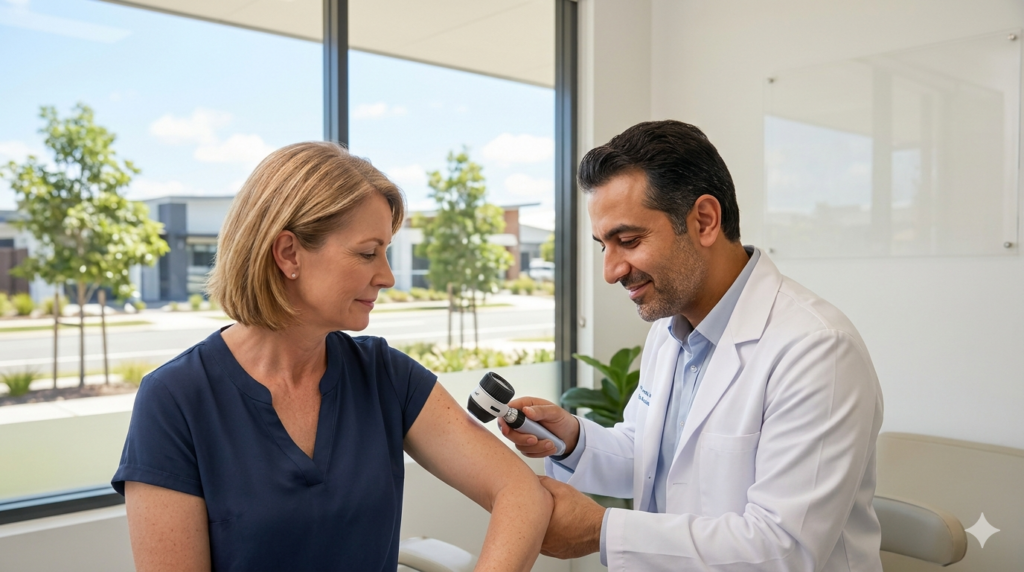
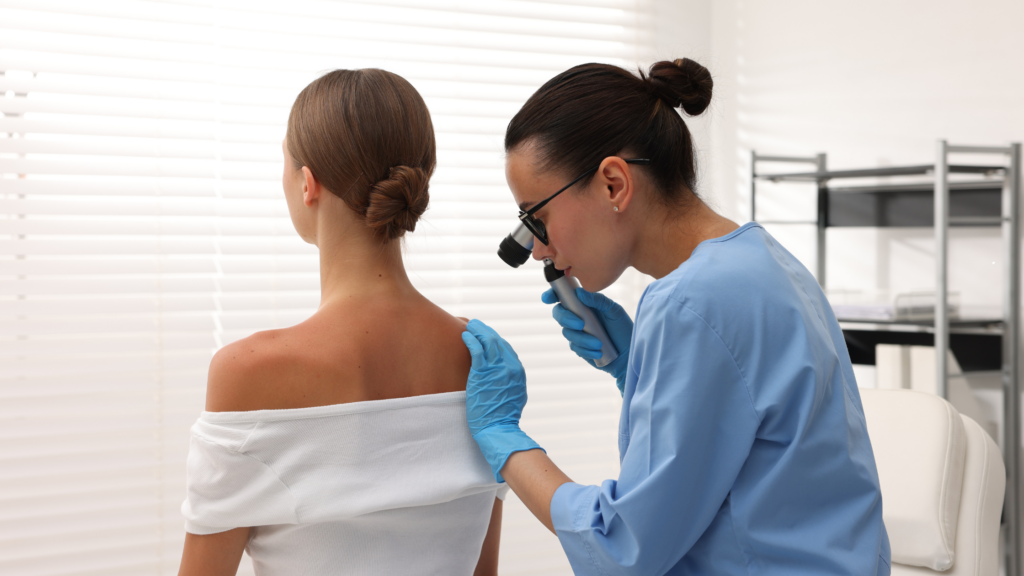
- Close-up examination: Your doctor uses a specialised, light-emitting magnifying tool called a dermatoscope. This allows them to see several layers below the surface of the skin to evaluate pigment patterns and blood vessels that aren’t visible to the naked eye.
- Mapping & documentation: Suspicious or complex spots are photographed and logged so they can be monitored for tiny changes over time.
2. “Why shouldn’t I just get a quick check from any doctor?”
Not all skin checks look at the same depth. While a standard visual check with the naked eye can spot obvious surface changes, advanced early detection relies on high-level training and specialised equipment.
| Standard Surface Check | FSCCA-Accredited Deep Dermoscopy Check |
| Tool: Naked eye or basic magnifying light | Tool: Polarised dermatoscope (up to 20x sub-surface view) |
| Focus: Visible changes (bleeding, dark colour, raised bumps) | Focus: Deep pigment structures and microscopic blood vessel patterns |
| Detection: Catches lesions once they become obvious | Detection: Spots abnormal cellular changes months or years earlier |
A deep skin check is only as precise as the clinician interpreting the dermoscopy. At SunMed Skin & Medical in North Lakes, skin cancer diagnosis and management are led by Dr Majid Alinia (MD, FRACGP, FSCCA).
- FSCCA Fellowship Accreditation: Dr Alinia holds a Fellowship with the Skin Cancer College Australasia (FSCCA), the highest level of primary care skin cancer accreditation available in Australia.
- Advanced Training: With over 15 years of medical experience, Dr Alinia holds advanced clinical certificates in both dermoscopy and skin cancer surgery.
- Comprehensive In-House Care: From microscopic dermoscopic evaluations to surgical excisions, skin flaps, grafts, and non-surgical field treatments, Dr Alinia provides complete skin care under one roof.
3. “What happens if the doctor finds a suspicious spot?”
Finding a spot doesn’t automatically mean you have skin cancer; it just means the doctor needs more information.
- Monitoring: If a spot looks low-risk but slightly unusual, your doctor may photograph it and schedule a quick follow-up in 3 to 6 months to check for subtle shifts.
- Biopsy: If a lesion needs closer evaluation, a quick, numbed tissue sample (biopsy) is taken in the clinic. This is sent to a pathology lab to determine exactly what cells are present.
Tailored Skin Cancer & Sun Damage Treatments Available at SunMed
If a biopsy confirms a pre-cancerous spot or skin cancer, SunMed provides a full spectrum of non-surgical and surgical treatments on-site in North Lakes, tailored to the type, stage, and location of the lesion:
Non-Surgical Treatments
For early-stage sun damage, pre-cancerous lesions (Solar Keratosis), or superficial skin cancers:
- Cryotherapy (Liquid Nitrogen): A fast, targeted freezing technique that destroys localised abnormal cells on the spot, allowing healthy skin to regenerate.
- Topical Field Therapies: Prescribed medical creams or ointments applied over wider areas (like the scalp, forehead, or forearms) to treat both visible sun spots and hidden, sub-surface precancerous damage.
- Curettage & Electrocautery: A minor procedure where superficial abnormal tissue is scraped away, and the base is cauterised using a gentle electrical current.
Surgical Treatments
When a lesion requires complete removal with clear microscopic margins, Dr Majid Alinia performs precise surgical procedures in SunMed’s fully equipped clinical room:
- Surgical Excision: Complete surgical removal of the cancerous lesion along with a safe, healthy surrounding skin margin to ensure no cancer cells remain.
- Flap Surgeries: Advanced reconstructive surgery that moves nearby healthy skin and tissue to close larger excision sites smoothly, maintaining natural contour and aesthetic appearance.
- Skin Grafts: Reconstructive care where a small piece of healthy skin is transplanted from another part of your body to restore larger or complex areas after cancer removal.
Don’t Ignore the Small Steps: Prevention Over Cure
It’s easy to dismiss a minor spot. So many people notice a small, slow-healing scab, a dry patch that won’t go away, or a light freckle and brush it off as a harmless nick, a routine bug bite, or a simple scratch.
In Queensland’s climate, these “minor inconveniences” are often sub-surface sun damage making itself known. Ignoring a changing spot or putting off an annual check is one of the most common mistakes people make, yet early detection remains your most powerful defence. When caught at an early, microscopic stage, skin cancers are highly treatable with simple, minimally invasive procedures.
Prevention and early action will always be better than a complex cure.
Taking 20 minutes out of your day for a professional skin assessment provides peace of mind and keeps you doing what you love outdoors safely.
Schedule Your Skin Assessment at SunMed North Lakes
Don’t wait for a spot to hurt, bleed, or become obvious. Protect your skin health by booking a thorough, FSCCA-accredited examination with Dr Majid Alinia today.